GST Registration Online
Get professional assistance for GST registration online in India, from eligibility and document verification to application preparation, filing support, ARN tracking and GSTIN certificate assistance. The exact processing time depends on the application, verification route and any clarification required by the tax authorities.
- Fast Approval with Accurate Documentation, Zero Errors, No Hidden Charges
- Smart Compliance Alerts to Avoid Late Fees & Penalties
- GST Registration, Return Filing, E-Invoicing & LUT – All in One Place
- Dedicated GST Expert for Your Business
- Trusted by 1,00,000+ Businesses Across India



1,12,845+
Happy and satisfied customers.
GST Registration Packages & Pricing
GST registration made simple – Get your GSTIN with expert filing support and transparent service.
Basic
Ideal for businesses requiring only GST certificate- GST Registration Support
- GST Certificate
- ARN Tracking
- Free Accounting Software
₹ 1,499 ₹ 3,499
/ Incl GSTEssential
Designed for new businesses starting their GST compliance journey- GST Registration Support
- GST Certificate
- ARN Tracking
- Free Accounting Software
- GSTR-1 Filing
- GSTR-3B Filing
₹ 1,999 ₹ 5,999
/ 3 Months Filing & Incl GSTAdvance
Tailored for businesses that want hassle-free, year-round GST compliance- GST Registration Support
- GST Certificate
- ARN Tracking
- Free Accounting Software
- GSTR-1 Filing
- GSTR-3B Filing
- Dedicated GST Expert
- GST Annual Compliance Support
₹ 9,899 ₹ 12,999
/ 1Yr Filing & Incl GSTNote: * Registration timelines are subject to GST portal verification and approval. Our experts will manage the complete application process and assist you until your GSTIN is successfully allotted.



Reviewed by Vaishnavi B (Chartered Accountant) - Experience: 20+ Years
GST registration is the process of registering a business under India's Goods and Services Tax (GST) system and obtaining a unique 15-digit GSTIN (Goods and Services Tax Identification Number). Whether registration is required depends on factors such as turnover, the nature of business, the type of supplies made and other conditions prescribed under GST law.
For startups, small businesses, service providers, traders and growing enterprises, understanding the applicable GST registration requirements is important before applying. The registration process is completed online through the GST official Portal and generally involves submitting business, PAN, address, bank and authorised signatory details, along with the required supporting documents.
With 19+ years of experience in GST and business compliance, Kanakkupillai provides professional assistance throughout the GST registration process. Our team helps review the required documents, prepare and submit the application, track the application GST Registration status and assist with GST department queries, where applicable. We focus on making the registration process clear, accurate and hassle-free, so business owners can complete their GST registration with greater confidence.
What Is GST Registration?
GST registration is the process through which an eligible person or business obtains registration under the Goods and Services Tax framework. After approval, the registered taxpayer receives a GST Identification Number (GSTIN) and a registration certificate. GST registration is the process through which an eligible person or business obtains registration under the Goods and Services Tax framework.
After approval, the registered taxpayer receives a GST Identification Number (GSTIN) and a registration certificate. Applying for GST Registration involves determining eligibility, preparing the required information and supporting documents, completing the application through the prescribed GST process, and responding to any verification or clarification requirements that may arise.
Who Needs GST Registration in India?
GST registration may be required when a person or business falls within the applicable compulsory-registration provisions or when the business chooses voluntary registration. The exact requirement depends on the nature of supplies, turnover, location, business model and other provisions applicable to the taxpayer.
- Businesses whose turnover crosses the applicable GST Registration threshold.
- Persons covered by compulsory-registration provisions.
- Businesses making supplies through e-commerce channels where registration is applicable.
- Certain interstate suppliers, subject to the applicable GST provisions and exceptions.
- Non-resident taxable persons and other specified categories where registration is required.
- Businesses that choose voluntary GST registration for commercial or compliance reasons.
Types of GST in India
1. CGST
Central Goods and Services Tax. It is levied by the central government when the buyer and the seller are in the same state.
2. SGST
State Goods and Services Tax. It is levied by the state government on the state where goods or services are consumed. It is applicable in addition to CGST on intra-state supply of goods and services.
3. IGST
Integrated Goods and Services Tax. It is applied by the central government when goods/services move from one state to another or are imported/exported.
4. UTGST
Union Territory Goods and Services Tax. It is levied by the central government when both the buyer and the seller are in the same Union Territory without a legislature, such as Chandigarh, Lakshadweep, and the Andaman & Nicobar Islands.
GST Registration Threshold Limit in India
Below are the GST registration threshold limits, which determine when a business must register for GST. Check if your business crosses the mandatory registration threshold:
| Business Type / State Category | Threshold for Goods (Annual Aggregate Turnover) | Threshold for Services (Annual Aggregate Turnover) |
|---|---|---|
| Normal Category States / UTs | ₹40 lakh | ₹20 lakh |
| Special Category States / UTs | ₹20 lakh | ₹10 lakh |

GST Registration Eligibility and Turnover Limit
Turnover is an important factor, but it is not the only factor that determines GST registration. The applicable threshold can depend on the type of supply, state or Union Territory, nature of the business and statutory exceptions. For businesses operating in Tamil Nadu, the applicable state-specific requirements should also be considered before submitting an application. Businesses can refer to the GST registration in Tamil Nadu guide for more information on the registration requirements applicable in the state.
For a service page, Kanakkupillai should publish the applicable current threshold figures only after checking the latest official GST/CBIC notifications and applicable state/UT position. This avoids presenting an oversimplified threshold as a universal rule.
Do I Need GST Registration? Check Your Eligibility
A quick eligibility review should consider more than annual turnover. A preliminary turnover calculation can help a business understand whether its figures may be approaching the applicable registration threshold, although turnover alone does not determine registration in every case. Businesses can use a GST Calculator as a starting point and then review the other factors that may affect their registration requirement.
- What is your business structure and principal activity?
- What is your aggregate turnover under the applicable GST rules?
- Do you make interstate supplies?
- Do you sell through an e-commerce platform?
- Do you fall under a category for which registration is compulsory?
- Are you an importer, exporter or non-resident taxable person?
- Are you considering voluntary registration?
If any answer creates uncertainty, get the position reviewed before submitting the application. Incorrect assumptions at the eligibility stage can lead to avoidable registration or compliance issues. Where the registration requirement depends on the business model, type of supply, turnover or other GST provisions, professional GST Advisory can help the business understand the applicable requirements before proceeding with the application.
Who Should Apply for GST Registration in India?
| Who Needs to Register GST? | Threshold / Condition | Example |
|---|---|---|
| Inter-State Suppliers | Registration is mandatory regardless of turnover. | If a seller in Maharashtra wants to sell to a buyer in Gujarat, GST registration is compulsory even if sales are below the above-mentioned threshold limit. |
| E-Commerce Operators and Aggregators | Registration is mandatory for turnover. | If you are selling your business online on e-commerce platforms such as Amazon, Flipkart, Zomato, or Swiggy, you must register for GST. Furthermore, the e-commerce operator must register for GST. |
| Casual Taxable Person (Occasional supply in a state without a fixed business) | Registration is mandatory regardless of turnover. | |
| Non-Resident Taxable Person (Foreign businesses supplying in India without a fixed place) | Registration is mandatory regardless of turnover. | A foreign company selling software services in India must register for GST. |
| Businesses under the Reverse Charge Mechanism (RCM) | Registration is mandatory regardless of turnover. | Example: A company receiving legal services must pay GST under RCM, so it must register. |
| Input Service Distributors (ISD) | Registration is mandatory regardless of turnover. | A head office that distributes input tax credit to branches must register as an ISD. |
| Agents of Suppliers | Registration is mandatory regardless of turnover. | Commission agents and brokers who supply goods/services on behalf of another person must register. |
| Voluntary Registration | If your income is below the threshold | Small businesses may register to claim ITC and improve business credibility. |
Why is GST Registration Mandatory for E-commerce Sellers?
- No Threshold Limit: Even the small sellers must register under GST.
- Tax Collection: Required to collect and remit GST on sales.
- Input Tax Credit: It helps sellers to claim credit on purchases.
- Platform Requirement: Amazon and Flipkart require GST details to list the products.
GST registration is an essential requirement for most Amazon and Flipkart sellers in India, ensuring legal compliance and business growth. Whether you operate from Chennai, Bangalore, or Mumbai, GST registration is essential for smooth and legal operations.
Do Amazon and Flipkart Sellers Need GST Registration?
Selling on platforms like Amazon and Flipkart requires compliance with the GST laws in India. Unlike traditional businesses, e-commerce sellers must obtain GST registration irrespective of their turnover. This rule applies because such platforms are treated as e-commerce operators under GST regulations.
GST Registration Under Rule 14A
Rule 14A is relevant to a specific route for certain applicants who satisfy the conditions prescribed under the GST framework. It should not be presented as an automatic three-day approval mechanism for every applicant.
- The applicant must satisfy the applicable conditions for the route.
- The applicable Aadhaar authentication and verification requirements must be completed.
- The application can be subject to the prescribed risk-based or verification process.
- Biometric or other verification may apply in cases covered by the applicable procedure.
- If the application is routed for additional verification or clarification, the overall timeline can change.
Before publication, verify the precise current wording, eligibility conditions and procedural interaction of Rule 14A and Rule 9A against the latest official GST/CBIC material.
Regular GST Registration vs Rule 14A
| Factor | Regular route | Rule 14A route |
|---|---|---|
| Eligibility | Depends on applicable GST registration provisions. | Only applicants satisfying the prescribed conditions can use the route. |
| Verification | May involve the applicable authentication/verification process. | Specific authentication and prescribed conditions apply. |
| Processing | Depends on application completeness and government processing. | May provide a faster route for eligible applicants, but is not an automatic guarantee. |
| Additional verification | May occur where required | Biometric or other verification may apply where prescribed. |
GST Registration Fees in India
The GST registration application on the government GST system generally does not involve a government application fee. A professional service provider may charge a separate fee for assistance with document review, application preparation, filing, verification guidance, tracking and post-filing support.
| Service component | What the customer should understand | Kanakkupillai presentation |
|---|---|---|
| Government registration application | Generally no government application fee for the registration application itself. | State separately from professional charges. |
| Professional assistance | Fee covers the scope of services included in the selected package. | Publish current package inclusions. |
| Additional work | Clarification, amendment or other services may have separate charges depending on scope. | Explain exclusions clearly. |
Benefits of GST Registration
When you apply for GST registration, you benefit from the following:
1. Save Tax Immediately - Claim ITC from Day One
When businesses buy goods/services, they need to pay the GST on those purchases. Later, when the business sells goods or services, it collects GST from its customers. The Input Tax Credit (ITC) allows a business to deduct the GST it has already paid on purchases (inputs) from the GST it has collected on sales (outputs).
For example, if you buy goods for ₹1,00,000 and pay ₹18,000 as GST, and later sell the finished product for ₹2,00,000 and collect ₹36,000 GST, you can deduct the ₹18,000 paid on your purchases from the ₹36,000 you collect on sales; thus, you pay only ₹18,000 to the government.
2. Business Credibility and Trust
Many businesses, especially in B2B transactions, prefer dealing with businesses registered with the GST. Registration provides credibility to your business and instils trust with your customers, suppliers, and investors.
3. Access to the Government Tenders and Contracts
Many government contracts, tenders, and projects require businesses to be GST-registered, especially the public sector undertakings (PSUs) and government procurement processes. Without GST registration, your business will be ineligible to participate in most of the government tenders.
4. Sell Anywhere in India - No State Barriers
A business registered under GST can conduct inter-state transactions without any limitations.
5. Export Without Paying GST - Zero-Rated Advantage
In GST, exports are zero-rated. This means that you don't have to pay GST on goods or services sold outside India. If you are a GST-registered exporter, you can claim a refund of the GST you already paid on raw materials, goods, or services used to make the exported product.
6. Access to GST-Linked Schemes
Several GST-related schemes are available for small businesses. Many small businesses with a turnover of up to ₹1.5 crore can opt for the Composition Scheme under GST. This scheme allows them to pay tax at a lower rate on their turnover without the need to maintain detailed records. Our GST Advisory Services can help you choose the right scheme for your business.
7. Get Loans Faster - Banks Trust GST Registered Businesses
Businesses registered for GST have greater credibility when seeking loans from banks and financial institutions.
Regular Scheme vs Composition Scheme — Which Is Right for Your Business?
This is one of the most common questions we receive from business owners and the answer depends entirely on your turnover, the nature of your customers, and how you sell. The Composition Scheme is designed for small, local businesses that want a simple fixed tax rate and minimal paperwork. The Regular Scheme is mandatory for businesses above the threshold and essential for anyone selling inter-state, listing on e-commerce platforms, or dealing with B2B customers who need to claim Input Tax Credit. Picking the wrong scheme at registration can block your ITC, restrict your sales channels, or force a disruptive mid-year switch all of which carry real compliance costs. The table below breaks down every key difference so you can make the right call before you apply.
| Feature | Composition Scheme (2026) | Regular GST Scheme (2026) |
|---|---|---|
| Eligibility (Turnover) | Up to ₹1.5 Cr (goods/traders), ₹75L (special states), ₹50L (services) | No upper limit - mandatory above ₹40L (goods) / ₹20L (services) |
| Tax Rate | 1%–6% fixed on total turnover | Standard slabs: 5%, 12%, 18%, 28% on transaction value |
| Input Tax Credit (ITC) | Not allowed - tax on purchases is a business cost | Fully available - offset purchase GST against sales GST |
| Interstate Sales | Prohibited - only intra-state supply permitted | Allowed - sell freely across all states |
| E-commerce Sales | Not allowed for goods (Amazon, Flipkart, Meesho, etc.) | Fully allowed on all platforms |
| Billing Document | Bill of Supply - cannot collect GST from customers | Tax Invoice - GST charged separately to customers |
| Compliance / Filing | Low - Quarterly CMP-08 + Annual GSTR-4 only | Higher - Monthly/Quarterly GSTR-1 & GSTR-3B + Annual GSTR-9 |
| Ideal For | Small B2C local traders, kirana shops, restaurants, micro-manufacturers | B2B businesses, interstate sellers, exporters, high-turnover businesses |
Documents Required to Apply for GST Registration in India
| Type of Applicant | Required Documents |
|---|---|
| Proprietorship/ Individual |
|
|
Partnership / LLP |
|
|
Private Limited / Public Limited Company |
|
|
Trust / Society / NGO |
|
|
GST Registration for Foreigners / Non-Resident Taxable Person |
|
Online Process of GST Registration in India
Obtaining your GST Registration will be straightforward if you follow the steps outlined below:
Prepare Your Required Documents
Before registering, make sure you collect all the necessary documents, including: PAN card; Adhar card; Proof of business address (electricity, water bill, lease agreement or similar); Bank proof (account statement, check, etc), and Entity Specific Documents (Partnership Deed; MOA; AOA)
Create Account on GST Portal
Visit www.gst.gov.in to register for an account by entering your PAN number and selecting your Taxpayer type
Fill Out the GST Registration Form
You will need to provide the following information to complete your application: Name of Business, Trading Name, Business Address, Bank Information, and Delegated signatories.
Upload Required Documents
After completing your registration form on the GST portal, you will be required to upload your supporting documents, such as your PAN card, Aadhaar card, proof of business address, proof of bank account, and Digital Signature Certificate (if applicable)
Track Application
Once you submit your application, you will receive an Application Reference Number (ARN) via email/text message. Please keep this DOB for future reference and to track your application's progress. You should also respond quickly to any requests for additional information from GST once the ARN has been issued.
Receive GSTIN and GST Registration Certificate
Once your application has been approved by GST, you will receive both the Digital GSTIN and Digital GST Registration Certificate.
File GST Returns
Once you have received your GSTIN Number, you should begin filing GST returns either monthly or quarterly. You should also maintain accurate records with the help of accounting services in India. If you ever cancel your registration, you will be required to file a GSTR-10 Final Return as a final compliance step.
From start to finish, most firms can get a GSTIN within a week, making it one of the fastest legal registrations to unlock compliance and business advantages.
| Step | Typical Timeframe | Action |
| Document preparation | 1-2 days | Collect PAN, Aadhaar, proof of business address, bank proof, and DSC (if required) to avoid delays. |
| Online application submission | Same day | Fill the REG-01 form and upload documents; ensure accuracy to avoid rejection. |
| ARN issuance & verification | 1 day | You get an Application Reference Number (ARN) instantly to track your registration. |
| Verification by GST authorities | 1-3 working days | Low-risk applications can be auto-approved in 3 days; some cases may take longer if additional information is required |
| GSTIN issuance | 3-7 working days | Once approved, GSTIN and a certificate are issued digitally; you can start operating legally and claim input tax credit immediately. |
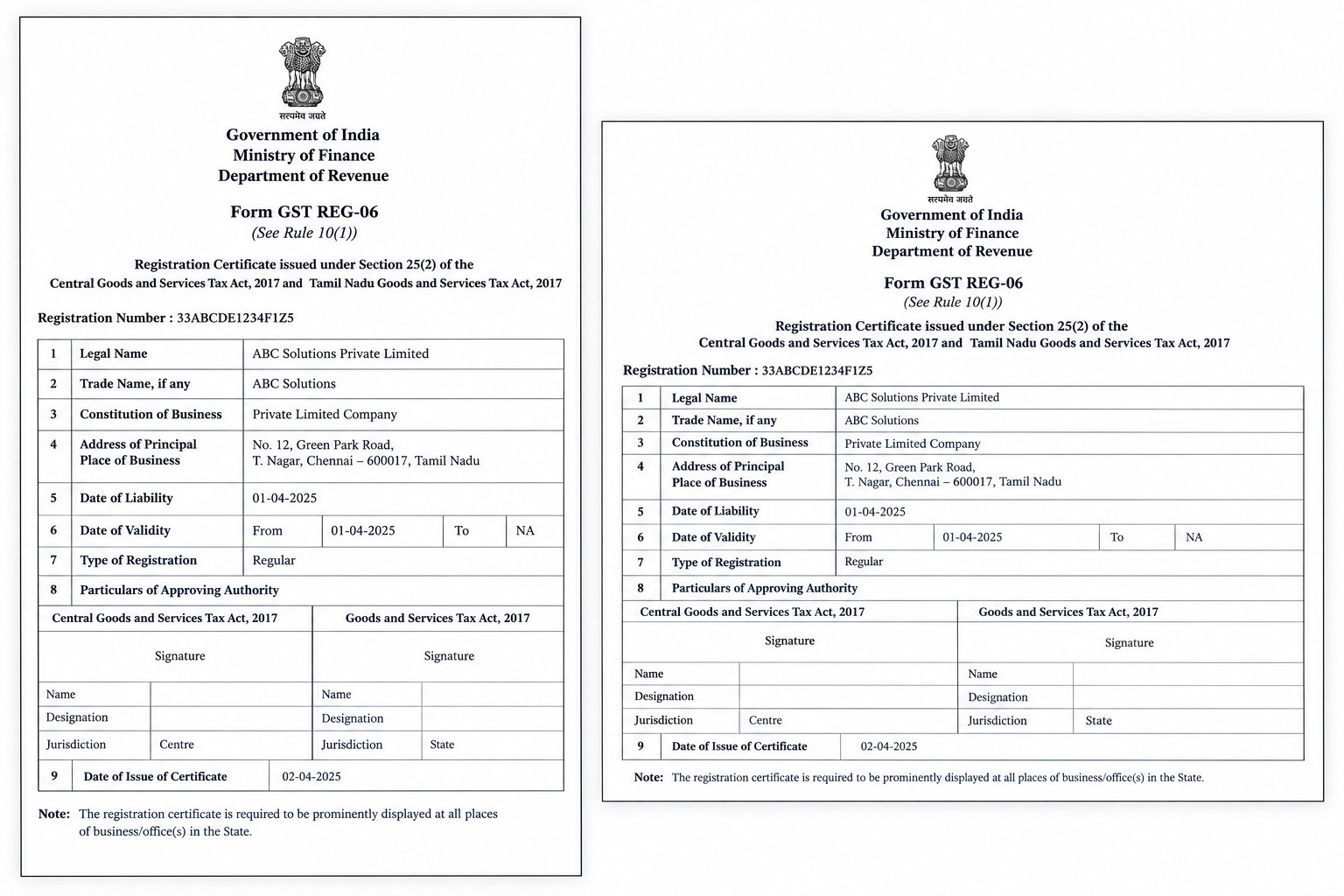
GST Registration Certificate and GSTIN
Once registration is approved, the taxpayer receives a GSTIN and registration certificate through the prescribed GST process. The GSTIN becomes an important identifier for GST invoices, returns and other compliance activities.
What Happens After GST Registration?
Getting a GSTIN is only the beginning of a business’s GST compliance journey. Once the registration is approved, the business needs to use its GSTIN correctly, maintain proper records and understand the filing and invoicing requirements that apply to its operations. Businesses involved in eligible exports should also understand the applicable requirements for supplying goods or services without payment of integrated tax, including GST LUT Filing where applicable. The following steps can help businesses stay organised and avoid common compliance issues.
- Download and retain the GST registration certificate.
- Use GSTIN correctly on applicable invoices and business documents.
- Set up tax invoices and appropriate HSN/SAC classification.
- Maintain sales, purchase and supporting records.
- Understand applicable GSTR-1 and GSTR-3B filing requirements.
- Track input tax credit and reconcile relevant records.
- Check whether e-invoicing or e-way bill requirements apply.
- Maintain a GST compliance calendar.
- Update registration details when changes require amendment.
- Understand the circumstances and prescribed procedures relating to GST Cancellation if the registration is no longer required or becomes subject to cancellation under the applicable GST provisions.
GST Returns After Registration
GST registration is the starting point of a business’s ongoing tax compliance. After receiving a GSTIN, registered taxpayers need to understand and meet the GST return filing, tax payment, invoicing, record-keeping and reconciliation requirements applicable to their business. The frequency and type of compliance may vary based on the taxpayer’s registration, turnover, business activities and the GST scheme applicable to them.
What to Do If GST Registration Is Rejected?
First identify the reason recorded by the department and check whether the issue can be corrected or whether a fresh application or other remedy is appropriate. Do not submit repeated applications with the same unresolved documentation problem. If a clarification notice or other communication is issued, review the requirements carefully and respond within the applicable deadline with the relevant supporting documents. Where professional assistance is required to prepare a response to a GST communication, businesses can seek support for GST Notice Reply.
GST Registration Online Yourself vs Professional Assistance
| Factor | DIY | Professional assistance |
|---|---|---|
| Eligibility review | You determine the applicable rules. | Professional review can help identify issues. |
| Document preparation | You collect and validate documents. | Documents can be checked before filing. |
| Application | You complete the online process yourself. | Provider assists with preparation and filing. |
| Clarifications | You handle communications yourself. | Assistance may be available depending on the package. |
| Tracking | You monitor status. | Providers can assist with tracking. |
| Cost | Lower direct cost. | Professional fee applies. |
GST Compliance After Registration
Once your GST registration is approved and GSTIN is issued, compliance responsibilities begin immediately. Proper GST Return Filing, correct HSN/SAC classification, and timely updates are essential to avoid penalties and ensure uninterrupted business operations.
GST Return Filing & Reporting
Every registered business must file periodic GST returns based on turnover and scheme eligibility.
- GST Return Filing (GSTR-1 & GSTR-3B) - Monthly or quarterly return filing as applicable.
- GST Nil Return Filing - Mandatory filing even when there are no transactions.
- GST Annual Return Filing (GSTR-9) - Annual compliance summary under GST law.
- GSTR-10 Final Return Filing - Required when cancelling GST registration.
HSN / SAC Code Compliance
Businesses must correctly classify goods and services using HSN (Harmonized System of Nomenclature) codes for goods and SAC (Service Accounting Codes) for services. Incorrect classification can result in notices, tax mismatches, or penalties during scrutiny — making periodic GST Audit a smart practice for every registered business.
LUT Filing for Exporters
GST LUT Filing - Submit a Letter of Undertaking to export goods or services without paying IGST.
Amendments & Registration Updates
Business changes must be updated on the GST portal within the prescribed time limits.
- GST Registration Amendment - Update address, partners, bank details, or authorized signatory.
- GST Registration Cancellation - Required when discontinuing business operations.
- GST Revocation Services - Restore cancelled or suspended GST registration.
GST Advisory & Notice Handling
Businesses may receive notices due to return mismatches, ITC discrepancies, delayed filings, or incorrect HSN/SAC reporting. Timely professional intervention prevents penalties and operational disruption.
- GST Notice Reply - Assistance in drafting and submitting replies to GST notices.
- GST Advisory Services - Expert consultation for ongoing compliance planning and risk mitigation.
Common Reasons GST Applications Get Rejected
Even though GST registration is processed online through the Goods and Services Tax Network under the supervision of the Central Board of Indirect Taxes and Customs, many applications are rejected due to simple errors:
Address Proof Mismatch
- Business address does not match the address on the utility bill, rent agreement, or supporting documents.
Aadhaar Authentication Failure
- Name mismatch between PAN and Aadhaar or OTP verification issues.
Wrong Business Activity Selection
- Incorrect business type or HSN/SAC codes selected.
Signature / DSC Errors
- Expired or invalid Digital Signature Certificate, or incorrect authorized signatory details.
Incorrect Bank Details
- Wrong account number, IFSC code, or unclear cancelled cheque.
Our experts review your documents to reduce the risk of rejection, ensuring accurate filing and faster approval of your GST registration.
Why Choose Kanakkupillai for GST Registration?
Choosing the right GST registration partner can make the difference between a smooth and hassle-free process. Here's why our services perform well and help your business succeed:
Professional Advice by Experienced Experts: We have a dedicated team of GST specialists, accountants, company secretaries, and tax advisors who understand the complications of GST law and procedures, including income tax audit requirements. From form filling to document validation, our experts ensure your application is accurate and complete, reducing the chances of rejection or queries from the department.
Hassle-Free Registration: A GST registration can be overwhelming if attempted alone. We handle the entire process for you, from document preparation to submission and status tracking, so you can focus on growing your business, not compliance paperwork.
Affordable Pricing: Our services are priced reasonably so that both small and large firms can avail professional support. This means you get expert service without burning your budget.
Timely Support & Long-Term Partnership: Becoming our client doesn't stop with just GST registration. We offer post-registration support, including guidance on return filing, compliance updates, and advisory services, helping you stay compliant and grow with confidence.
Proven Track Record of Client Satisfaction: We emphasise your satisfaction throughout each phase. With consistent positive reviews, fast turnaround times, and a strong focus on compliance deadlines, we ensure you get reliable service and support exactly when you need it.
Selecting us means less stress, fewer errors, and faster GST registration. So you can get your GSTIN, claim tax benefits, and unlock new business opportunities with confidence.

Frequently asked questions
A GST registration provides a GSTIN, which is necessary to become legally compliant, claim input tax credits, sell between states, sell on e-commerce platforms and establish trust with your customers and suppliers.
The following persons need to register under GST: businesses with a turnover exceeding a specified threshold, suppliers selling between states, e-commerce sellers, non-resident taxable persons and certain service providers.
No, it is not compulsory; however, it is a good idea to register voluntarily in order to claim input tax credits, expand to other states, and improve credibility.
When applying for GST, some common mistakes include submitting incorrect documents; misunderstanding the meaning of ‘composition scheme’; failing to meet required filing deadlines; not completing invoices in the correct manner; failing to resolve discrepancies between GSTR-2A and GSTR-3B; failing to verify their GSTIN before filing returns; and ignoring notices of compliance.
Yes. Proprietorships can apply for GST registration once their total turnover exceeds the annual threshold or if they intend to fully comply with domestic e-commerce laws.
Yes. If an NGO/trust/society has total turnover exceeding the threshold, or engages in selling taxable supplies, GST registration is required. Required documents include, but are not limited to, registration certificate, PAN, bank proof and explorer certifications.
All eCommerce platform sellers must register for GST irrespective of the amount of turnover.
Gather necessary documents → create a user account on GST Portal → fill out REG-1 → upload documents → submit, receive your ARN → get approval → receive your GSTIN.
Low-risk applications typically take 3-7 working days from the date of submission provided all supporting documents are correct.
For the most part, GST registration is at no cost to the applicant, however, the applicant may incur costs associated with obtaining a Digital Signature Certificate (DSC) for a company or LLP, or hiring a professional to assist him/her with the application.
A DSC is compulsory to verify the identity of a company or LLP when digitally signing forms/forms securely; which results in submitting a valid application and receiving quicker approval.
Yes, non-resident persons wishing to supply goods or services to India must register for GST before commencing business in India.
The ARN is generated at the time of submission of the application and is issued to allow the applicant to track the status of their application online.
To check the status of your GST registration application, log on to the GST portal by using your ARN number and responding to any challenges or questions promptly.
You can register for GST voluntarily, provided you would like to claim input tax credit, build credibility for your business, and can sell to customers outside of your State, or on an online platform.
Input tax credit, legal compliance, eligibility to bid for government contracts, eligibility to sell on e-commerce platforms, and building trust/credibility for your business.
With GST registration, you will have the ability to offset the GST you have paid on your purchases from the GST you collect on your sales and thereby reduce your overall tax liability and improve your cash flow.
No. If you sell products to consumers in another State without having GST registration, you may face penalties or have your transactions blocked.
Yes, the frequency at which you must submit your GST returns will depend on your total sales for the year, as well as your tax classification type. Most businesses must submit a GSTR-3B form each month and a GSTR-1 form every quarter.
GSTR-1 contains all details about goods that you have sold to your customers. Whereas GSTR-3B is primarily a summary of the sales and purchases you made during that month, along with summary of tax liability.
No, e-invoicing only applies to companies whose annual sales are more than ₹50 lakh per year (as prescribed by government).
Yes, because businesses must comply with government regulations, having a GST registration number will demonstrate a commitment to legal compliance (which builds confidence with customers and vendors).
Rule 14A provides a specific registration route for eligible applicants subject to prescribed conditions and verification requirements. The current conditions should be checked against the latest applicable GST rules.
The next procedural step depends on the applicable GST verification route. Additional verification or biometric authentication may be required in relevant cases.
Yes. An application may face rejection or delay if the information is incomplete or inconsistent, supporting documents are inadequate, or prescribed verification requirements are not satisfied.
Not every freelancer automatically needs GST registration. The requirement depends on factors such as turnover, nature and location of supplies, and applicable compulsory-registration provisions.
Might Be Looking For



Meet Our Trusted Professionals



Trusted by 1,12,845+ Happy customers are using Kanakkupillai!